
Imagine you need to move quickly: a sudden price swing in BTC and an opportunity to buy dips on a liquid spot pair. You open your browser, navigate to OKX, and—before you can act—you’re blocked by a forgotten 2FA device, a slow KYC verification, or a phisher’s mirror site. That practical scene captures what matters: logging in and accessing spot markets is not just a convenience task; it is the critical operational hinge between strategy and outcome.
This explainer walks through how OKX’s Web3-enabled stack works for a US-based trader who wants reliable access to spot markets, what security and regulatory mechanics shape that access, where the system can fail, and how to make operational choices that trade off speed, custody, and risk. The goal is a reusable mental model: when to use the centralized exchange flow, when to reach for the non-custodial wallet, and which failure modes to harden against before you press submit.
How OKX Login Works: mechanics, KYC, and layered protections
At the core, an OKX account is a centralized identity and custody object that sits behind a login flow. The technical pieces you meet are: username/email, password, mandatory 2FA (SMS, Google Authenticator, or biometrics on mobile), and a KYC checkpoint that ties the account to a government ID plus a liveness check. For US customers, the KYC step is effectively compulsory if you want to trade spot or margin at scale, withdraw fiat, or use derivatives—an outcome of AML regulation rather than exchange preference.
Two mechanisms reduce common failure modes. First, AI-driven threat detection evaluates login patterns and can trigger extra verification when it sees atypical behavior. Second, cold storage and multi-signature withdrawals protect assets on the custody side: OKX keeps over 95% of held cryptocurrencies in air-gapped cold wallets requiring multiple approvals. These are complementary: login security prevents unauthorized access, while cold storage limits the damage of a successful compromise.
That said, there are clear limits. KYC is a point-in-time verification—not a guarantee against account takeover. If your device is compromised, session tokens or SMS 2FA can be intercepted. Likewise, the non-custodial Web3 wallet that OKX offers transfers responsibility: you control the seed phrase and thus assume irrecoverable risk if it is lost. The practical heuristic is simple: custodial convenience buys recoverability and features (fiat rails, margin, derivatives); non-custodial control buys sovereignty and reduced counterparty risk at the cost of self-rescue burden.
Spot Trading on OKX: platform features and what they mean for execution
Spot trading on OKX is the native buy/sell market for immediate settlement. Mechanically, it relies on order books, market and limit orders, and matching engines that prioritize price-time priority. OKX supports over 300 assets including BTC and ETH and maintains liquidity for major pairs; however, the exchange periodically delists pairs that no longer meet listing standards—recently a set of low-volume or risky tokens were removed to preserve market quality. That delisting behavior is worth watching: it signals that illiquid or novelty tokens can be removed quickly, and positions in those assets may become harder to exit.
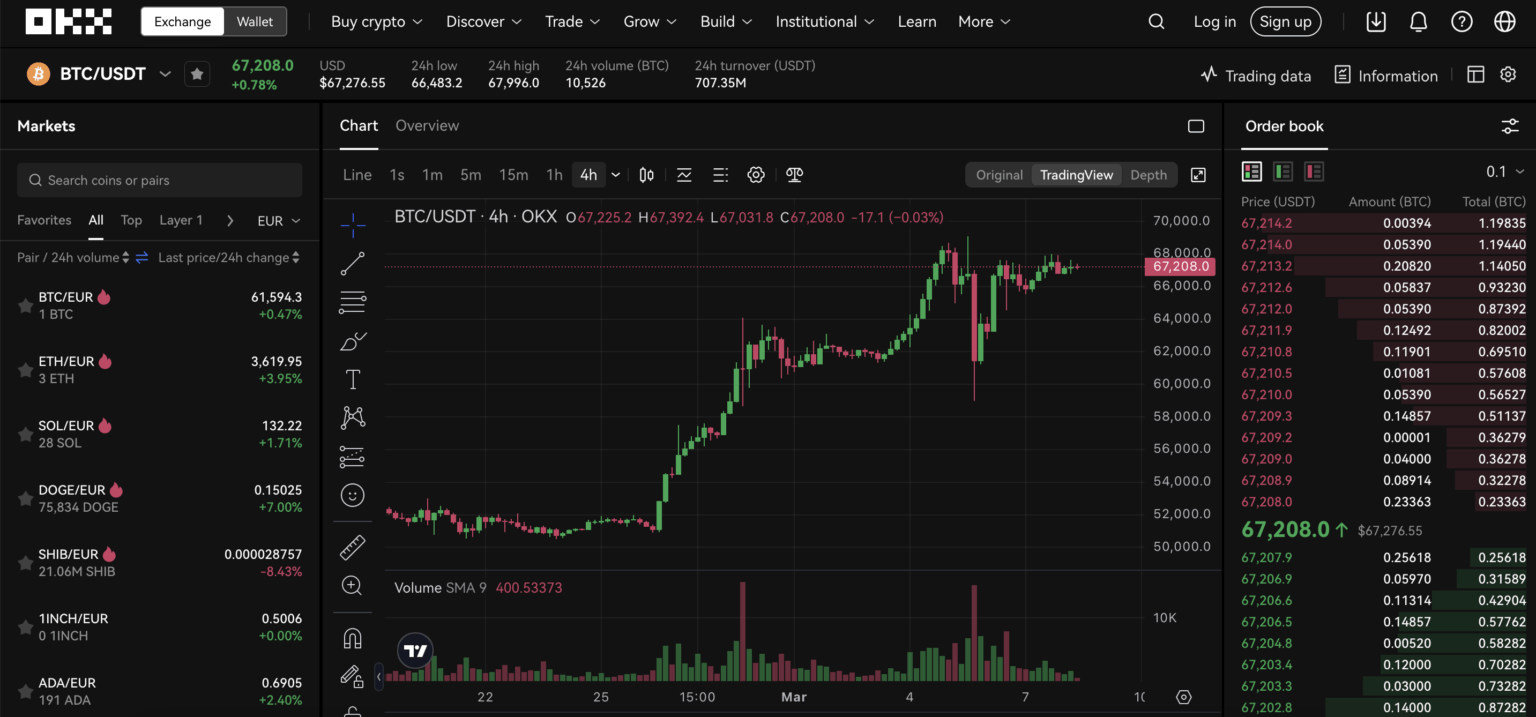
If you are trading spot as a US-based trader, you will see platform-level features designed for execution quality: advanced TradingView charting, order types (stop-limit, OCO), and a DEX aggregator for cross-chain swaps when you bridge into Web3. Execution risk is mainly slippage during fast moves and bid-ask spread on thin pairs; margin and derivatives introduce leverage-specific liquidation mechanics that are separate from spot but can affect funding rates and liquidity in the wider market.
One operational detail traders underappreciate: the login path and account settings materially affect execution speed. Mobile biometric login is fast and can make sense for intraday reactions, but it requires device security hygiene. Desktop trading via the web gives the most charting and order sophistication but needs careful session management (avoid persistent logins on shared machines). A practical step right now is to verify your login method, confirm 2FA backups, and if you use a hardware wallet integration for the OKX Web3 wallet, test a small swap so you know the UX before committing capital.
Web3 Wallet vs. CEX Account: a decision framework
Traders must choose along three axes: custody, speed, and feature access. The centralized OKX account gives fiat on/offramps, spot & margin, staking, derivatives access, and Proof of Reserves transparency—important if you value exchange solvency signals. The non-custodial Web3 wallet gives private-key control, hardware wallet compatibility, and direct DeFi access but lacks exchange-backed recoverability and fiat rails.
Use cases:
– If you need instant access to fiat or want margin/leverage, prefer the centralized account.
– If you plan to interact with DApps, hold NFTs, or manage keys across chains, prefer the Web3 wallet.
– If you want yield (staking, DeFi farming with auto-compounding), you may combine both: custody on exchange for liquid capital and a hardware-backed wallet for long-term positions and DeFi exposure.
Trade-offs are real. Keeping funds on a CEX reduces the friction to execute but concentrates operational risk in the exchange and in the login sequence. Moving funds to a self-custodial wallet removes counterparty risk but introduces the single biggest failure mode in crypto: lost seed phrases. A simple rule of thumb: split funds by timeline and intent—operational capital for trading on the exchange; archival capital in hardware-backed self-custody.
Security failure modes and how to harden them
Three failure modes dominate: phishing/login interception, device compromise, and DeFi smart-contract risk. Phishing is the most common. The attack is simple: trick you into entering credentials on a lookalike site and then drain funds or request unwanted withdrawals. Defend with a bookmarks-first habit (always use a saved bookmark), hardware-backed 2FA when available, and by checking site TLS and domain spelling—small time taken prevents large losses.
Device compromise (malware, clipboard hijackers) is mitigated by isolating high-privilege actions to secure devices: use a dedicated trading machine or a hardware wallet for signing important transactions. For DeFi interactions through the OKX DEX aggregator, recognize that routing through multiple contracts increases exposure to smart-contract risk. The aggregator finds efficient paths, but aggregating across chains or protocols increases the attack surface—size your trade accordingly and keep gas/slippage tolerances conservative.
One sharper mental model: custody as an options surface
Think of custody and interface choices as a portfolio of options. Each mode (CEX, non-custodial hot wallet, cold hardware wallet) has a cost (speed, convenience), a counterparty exposure (exchange solvency, smart contract risk), and a recovery profile (support help vs. irrecoverable loss). Instead of asking “which is better”, ask “which option improves my portfolio’s convexity for the task at hand?” For quick market-making or capturing intraday moves you need convexity in execution (favor CEX with tested login methods). For long-term value capture and governance voting, you need convexity in control (favor hardware-backed non-custodial custody).
Before you trade: confirm KYC completion if you intend to use full features; check 2FA and backup codes; practice a small withdrawal to new wallet addresses; and confirm that any tokens you plan to trade are not in the delisting watchlist. If speed beats complexity in your strategy, prioritize fast, secure login paths (biometrics + device hygiene) and keep only the trading capital on exchange.
What to watch next
Signals that change the calculus: significant policy shifts in US AML/KYC rules, large delisting waves that affect liquidity in niche tokens, or further transparency reports on Proof of Reserves. Each would change the trade-off between keeping funds on the exchange and moving them to self-custody. Also monitor on-chain activity related to wrapped or tokenized real-world assets supported by OKX—if market depth thins or spiking volatility occurs, spot liquidity can evaporate quickly.
If you’re ready to log in now, use this direct route to the official login guidance and make sure your 2FA is set up before trading: okx sign in
FAQ
Is OKX safe for US users?
Safety is relative. OKX uses strong institutional controls—cold storage with multi-signature, Proof of Reserves transparency, and AI-driven login protections. Those measures reduce platform risk but do not eliminate phishing, device compromise, or personal-key loss. For US users, KYC increases regulatory compliance but also ties accounts to identity, which has its own privacy and operational implications.
Should I use the OKX Web3 wallet or the centralized exchange account?
Use both, intentionally. Keep short-term trading capital and margin-enabled positions on the centralized account for speed and features. Keep long-term holdings, private keys for governance, and high-value NFTs in the non-custodial wallet with hardware protection. The correct split depends on your time horizon and tolerance for self-recovery responsibility.
What causes delisting and how does it affect spot trading?
Exchanges delist pairs when liquidity, project health, regulatory risk, or tokenomics degrade. Delisting reduces available exit routes for that token and can widen spreads for related markets; traders holding delisted assets should plan exits before liquidity deteriorates.
How do I reduce login-related trading friction?
Pre-verify KYC, set up multiple 2FA methods (authenticator app and biometric), keep emergency backup codes offline, and use a trusted device for execution. Test your process with small trades and withdrawals so you have practiced the full workflow before capital is on the line.